Official partner
Collect More Light. Keep More Light. Detect More Light - This may sound simple, but it’s the driving force behind all Wasatch does – because it makes for good spectroscopy. Wasatch Photonics has designed high NA (low f/#) spectrometer input, which captures more light from the sample. All optics, parts and electronics are designed to match.
Collect More Light. Keep More Light. Detect More Light - This may sound simple, but it’s the driving force behind all Wasatch does – because it makes for good spectroscopy. Starting with the proprietary volume phase holographic (VPH) gratings on which the company was founded, we’ve designed a spectrometer that maximizes efficiency at every step. By keeping more light in the optical path, we reduce stray light within the bench, thus increasing signal while reducing noise. Wasatch Photonics has designed high NA (low f/#) spectrometer input, which captures more light from the sample. Our user-configurable probes have been designed to match, and come with compatible fibers to maximize light collection.
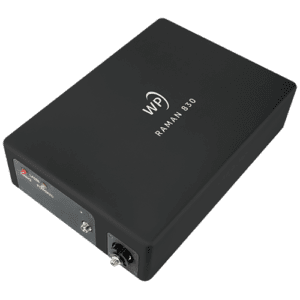
Check out our X series Raman spectrometers
We’ve redesigned our signature high-sensitivity optical bench to be more configurable, more robust & more reliable than ever. This highly comprehensive, compact Raman product line includes modular spectrometers, integrated lasers, complete systems, and OEM modules ideal for either research and product development – or both! With choices for wavelength, f-number, optical coupling, slit size & detector, you’ll find the perfect balance of sensitivity & resolution to take your Raman measurements to the next level.
At the research/innovation stage, start with a lab-friendly unit configured to your exact needs – and reconfigurable for future projects. These Raman spectrometers & systems cover the fingerprint and functional region with <10 cm-1 resolution, making them suitable for most identification, diagnostic, and process applications. Choose from 532 to 830 nm models.
Did you ever wonder?
- Higher sensitivity; Raman is a low-light technique, which makes every photon precious. A general-purpose compact spectrometer may not have the sensitivity needed to capture sufficient Raman signal without accumulating excess background noise. The ideal portable Raman spectrometer is designed around a few simple principles – collect more light, keep more light, detect more light. We design every Wasatch Photonics portable Raman spectrometer for maximum sensitivity – to collect more signal from weak Raman emitters compared to other spectrometers. Even low concentrations can be measured, thanks to higher signal and cleaner spectra.
- Wasatch Photonics Raman spectrometer designs use a low f/# (high NA) input to increase light collection, our own patented VPH transmission gratings for maximum diffraction efficiency at all wavelengths, and custom optics to achieve diffraction-limited optical design. This combination yields a superior, high throughput optical bench for low light level applications, which we match to the best detectors for each application. The result? You can collect more Raman signal in a shorter period of time – for better signal-to-noise, lower limits of detection, and faster back-to-back measurements.
- Collect more light – We use a high NA (low f/#) spectrometer input, which captures more light from the sample. Our user-configurable probes have been designed to match, and come with compatible fibers to maximize light collection.
- Keep more light – At the heart of each spectrometer is one of our own VPH transmission gratings, offering high efficiency over broad bandwidths with little polarization sensitivity and minimal scatter. This allows us to use a Littrow configuration for a small footprint, easier alignment, and less temperature sensitivity. The transmission-based design also preserves symmetry to ensure better focusing of light onto the detector plane, and allows the use of custom AR-coated lens systems to reduce aberrations to below the diffraction limit – keeping every possible photon.
- Detect more light – We scour the market for the best detectors, looking for low noise, excellent sensitivity, and fast data readout. We offer a choice of detectors to meet a variety of application and use-case needs, from small, cost-effective, uncooled detectors for rapid handheld measurements to premium, ultra-cooled detectors for research (and everything in between!).
- Laser Wavelength Calibration – The final calibration to be performed at the factory is the determination of the exact excitation laser wavelength. Lasers with a given (nominal) Raman wavelength are specified to fall within a wavelength range of typically ± 0.5 nm, which at a Raman excitation wavelength of 830 nm corresponds to a Raman shift of about 7 cm-1. For best accuracy, the exact laser wavelength therefore needs to be determined using the well-known Raman peaks of a reference substance, ideally one published in ASTM 1840-96 (2014)3, for which the peak positions are defined to better than 1 cm-1 wavelength accuracy.
- Day-to-Day Wavenumber Correction – For highest accuracy spectroscopic measurements, it is necessary to account for the small, but noticeable, day-to-day overall variations in the entire system. This correction to the final wavenumber axis captures any minor changes in the laser wavelength, spectrometer wavelength calibration, or other minor shifts of the spectrum, for example due to external temperature changes. Raman instruments at every performance level have been shown to require a day-to-day correction to achieve reliable standardization of Raman spectra for transfer of spectral libraries across instruments.
- Relative Intensity Calibration – As a demonstration of how to perform the intensity calibration, we measure the emission from a standard reference material sample specific to the 830 nm laser wavelength (SRM 2246). A full list of available relative intensity correction standards for Raman spectroscopy can be found at the NIST website SRM Home and ASTM E29111-13 (2013)2. The emission spectrum for SRM 2246 was measured for each individual WP 830-L spectrometer, normalized, and compared to the expected (normalized) emission spectrum as specified by NIST.
- Wasatch Photonics develops by the “OEM by Design” philosophy through decades of collaboration with customers, transforming research concepts into application-ready products. Along the way, Wasatch recognized the need for robust, thermally stable, high-performance components that deliver repeatable results from prototype to production and from unit to unit.
- By providing OEM-grade products from the start, they accelerate development while reducing risk. Customers can use the same modular Raman platforms and ENLIGHTENTM software trusted by researchers for R&D and proof-of-concept work, with confidence that performance and analytical methods can transition seamlessly to volume production.
- With more than 200 Raman OEM customers spanning the full product lifecycle, from initial prototypes to high-volume production, Wasatch Photonics is an established supplier of scalable Raman spectrometers and systems.